Screen Time as a Reward: What Game Design Says
Parents in 2026 are treating screen time as an earned reward, not an entitlement. Game designers figured this out decades ago. Here's the behavioral science behind why it actually works.

AJ Campos · Co-founder & CEO
· 7 min read
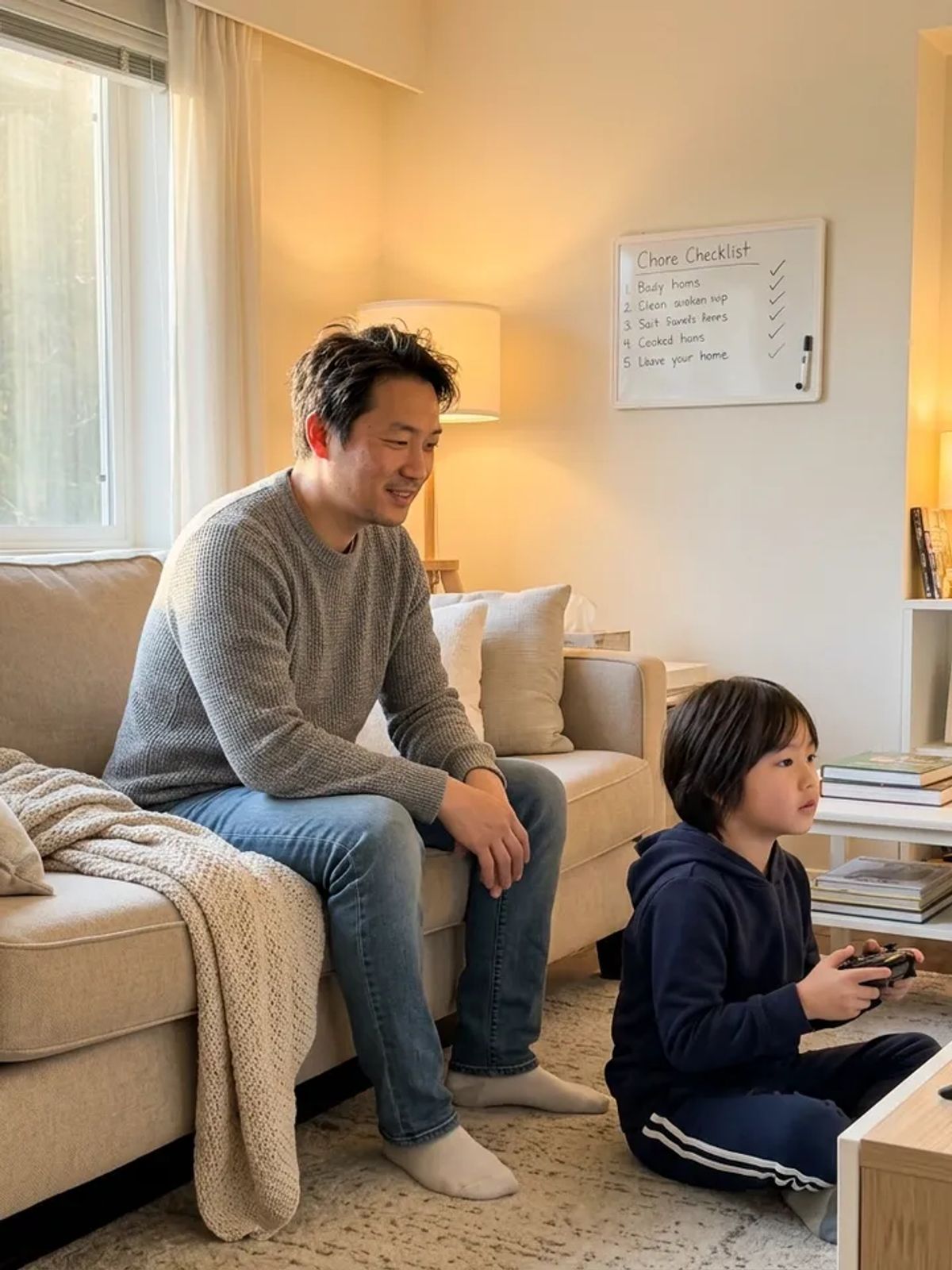
Two-thirds of American parents now limit how much screen time their kids get, according to CivicScience. That's up from roughly half in 2020. The number is moving fast.
And if you have been on Pinterest lately, you already know what the aesthetic looks like. According to the Pinterest 2026 Parenting Trend Report, searches for "no phone summer" are up 340 percent. "Screen-free activities" is up 200 percent. "Digital detox aesthetic" is up 95 percent. Parents are restructuring household life so that outdoor time, reading, and chores come first. Screen access follows. It's conditional now.
Here's the thing. That's not a parenting trend. That's operant conditioning. And game designers have been doing it on purpose for about 50 years.
What Skinner Actually Said
B.F. Skinner spent the mid-20th century mapping how behavior is shaped by consequences. The short version: behaviors that produce rewards get repeated. Behaviors that don't get abandoned. This is not controversial. It is foundational behavioral science, well-established long before the first iPhone shipped.
What Skinner also found, and what matters here, is that the timing and structure of rewards changes how powerfully they work. A reward you had to earn lands differently than one you just receive. The anticipation is part of the mechanism. The effort creates investment.
Parents in 2026 are discovering this. Skinner knew it in 1953. Game designers figured it out somewhere in between.
Game Designers Have Known This Forever
I have been playing games for over 25 years, from early FPS titles through modern RPGs. The reward loop is not an accident in any of those games. It is the architecture.
Here is how it works at a basic level. You have a task. The task has a cost (your time, your attention, a degree of difficulty). Completing it produces a reward. The reward is withheld until the task is done. That sequence is the loop.
What makes it motivating is exactly what makes the new parenting approach motivating: the reward is not free. Free rewards stop working almost immediately. If every chest in a dungeon is unlocked, nobody cares about opening chests. The lock is the point. The earned quality of the thing is what gives it value.
See also: why games are addictive, and how you can use it for good.
Screen time as a reward for kids works on the same axis. When screen time is always available, it is wallpaper. Kids absorb it passively and still want more, because there is no loop. When screen time requires something first, the structure creates meaning on both ends. The chore has a payoff. The screen time has a cost. Both matter more.
The Structure Is What Most Parents Get Wrong
The idea is simple. The execution is where things fall apart.
Here are the most common failure modes:
- Vague conditions. "Clean your room" is not a task with a clear completion state. A 10-year-old and a 40-year-old will disagree on what that means every single time. Specific tasks with observable outcomes work. "Vacuum the living room" works.
- Inconsistent enforcement. The rule holds until a parent is tired, or late, or just doesn't feel like the argument today. Kids are fast pattern-matchers. They will find the inconsistency and camp on it.
- No reset mechanism. What happens on Monday? What happens if a kid was sick Wednesday? If the rules don't account for exceptions and fresh starts, the system accumulates resentment and collapses.
- Rewards that don't land. A kid who doesn't care about extra screen time will not be motivated by the promise of extra screen time. The reward has to match the kid.
Game designers solve all four of these in their sleep. Clear task definitions, consistent rule enforcement, weekly resets, and reward systems you can tune per player. This is table stakes in game design. It should be table stakes at home.
What "Earning" Screen Time Actually Looks Like
Let's be concrete about what a working system looks like.
Tasks need to be specific and verifiable. "Unload the dishwasher" is verifiable. Photo verification works well here because it removes the debate. Either the dishes are put away or they aren't. The evidence is the evidence.
Rewards need to be legible. Kids should know, in advance, what they are working toward and what it costs in points or effort. This is not a complicated concept. Every vending machine on earth operates this way. You can see what you want. You can see the price. You put in what it costs and you get the thing.
The system needs a reset. Weekly resets are the right cadence for most families. Long enough that momentum builds, short enough that a bad week doesn't turn into a bad month. Monday is a clean slate. This is also how most competitive games handle their ranked seasons.
And the system needs to be transparent to all parties. Kids who can see their own progress stay engaged. Kids who are just being handed instructions with no visibility into the scoreboard are being managed, not motivated. There's a difference.
Why This Works Better Than Time Limits Alone
Setting a time limit on screen use is a restriction. It addresses a symptom. It does not change the underlying dynamic.
What the earn-first model does is different. It reframes screen time as a currency. The kid is not being denied something. The kid is working toward something. That framing shift is not trivial. It changes who holds agency in the transaction.
This is also consistent with what the gamification research literature shows about extrinsic rewards used well: when the reward is clearly linked to a behavior, and when the behavior itself is achievable and meaningful, the system tends to produce follow-through. Where it breaks down is when the reward is disconnected from the behavior, or when the tasks feel arbitrary.
Chores are not arbitrary. They are real household contributions. That gives them a dignity that a random game task does not have. The kid is doing something that actually matters. The screen time they earn is a genuine exchange, not a manipulation.
For more on how reward structures interact with motivation in kids, the post on why sticker charts stop working is worth reading alongside this one.
The Part About Screen Time Rules in Practice
One practical note on screen time rules that parents often overlook: the rules need to be the same every day, not stricter on Tuesday because someone had a frustrating morning.
Consistency is the load-bearing wall. A kid who knows that the rule is predictable will work within it. A kid who suspects the rule is actually just their parent's mood will test it constantly. Not out of defiance. Out of rational calibration. They are learning the actual system, not the stated one.
If you want screen time rules to hold, they have to be mechanical. Written down. Visible. Same inputs, same outputs, every time.
That is how games work. It is also how trust works.
Where Chore Battles Fits
I want to be straightforward about this part: I am not going to tell you Chore Battles is the only way to run this kind of system. A spreadsheet and a whiteboard can work fine if you apply the principles above consistently.
But if you want a system that has these mechanics already built, Chore Battles is designed for exactly this. Kids ages 6 through 17. iOS and Android. The core loop: kids complete chores, a creature they own grows with each completion, and the whole family works together on a weekly boss. The leaderboard resets Monday. Sick days are protected.
The Rewards Store is the part relevant to this post. Parents set the rewards. Screen time is a common one. Kids cash in earned points for whatever you decide is on the table: extra screen time, a treat, allowance, anything. The system is transparent to the kid and controlled by the parent. Photo verification handles the "did you actually do it" question.
It is COPPA compliant. No targeted ads at kids. Data is not sold. Those are not marketing claims. They are structural commitments.
It is waitlist-only right now. If you want to follow along: yulixis.com/chore-battles.
The Actual Takeaway
Parents in 2026 are figuring out that screen time works better as a reward than as a default. Pinterest search data confirms the shift is happening at scale. The behavioral science explaining why it works has been settled since the 1950s. Game designers have been applying it systematically for decades.
None of this is new. It just looks new if you have not been paying attention to reward loops.
The structure is the product. Build a consistent one and most of the arguing stops on its own.
Chore Battles
A chore tracker that runs like a game — creatures that grow, a weekly family boss, and a leaderboard that resets every Monday. Free to download.
Join the waitlist