Sticker Charts Stop Working: Intrinsic vs Extrinsic Motivation
Sticker charts die in about two weeks. The reason is intrinsic vs extrinsic motivation, and the research is 50 years old. Here's what the data says and how to use rewards without breaking the thing you wanted.

AJ Campos · Co-founder & CEO
· 6 min read
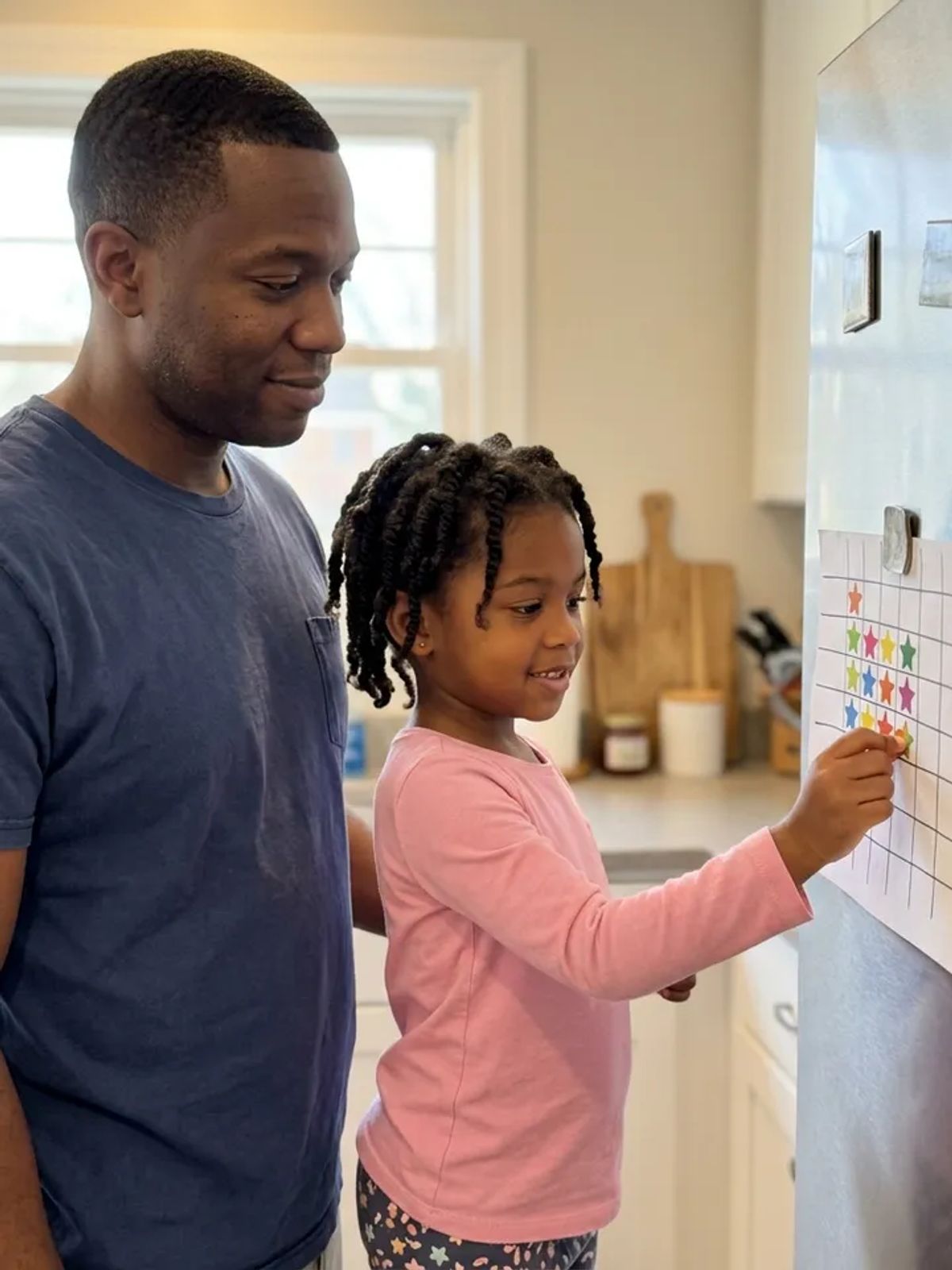
The sticker chart works for about two weeks. Then it doesn't. You did not do anything wrong. The chart was always going to fail, and we have known why since 1973.
The short version is that you ran into the difference between intrinsic vs extrinsic motivation without being told there was a difference. Intrinsic motivation is doing a thing because the thing itself is worth doing. Extrinsic motivation is doing a thing to get a sticker. A sticker chart is a machine for converting the first kind into the second kind, and the second kind has a much shorter shelf life.
I design reward systems for a living. I have also kept a chore chart on my own refrigerator. Both of those facts inform what follows.
The study every parent should know about
In 1973, three researchers (Mark Lepper, David Greene, and Richard Nisbett) found a group of preschoolers who already liked to draw. Not "would draw if asked." Liked it. They drew during free time when no one was watching, which the researchers confirmed through one-way mirrors before the experiment started.
Then they split the kids into groups. One group was promised a fancy "Good Player" certificate for drawing. One group got the certificate as a surprise afterward. One group got nothing.
A couple of weeks later, they measured how much each group chose to draw on their own. The kids who had been promised a reward drew about half as much as the others. The paper is titled "Undermining children's intrinsic interest with extrinsic reward," which is not subtle, and the full text is available here.
Read that again. The reward did not boost the behavior. It cut it in half. They took kids who loved drawing and taught them that drawing is a thing you do for a prize. Once the prize stopped being interesting, so did the drawing.
This has a name. It's called the overjustification effect. The brain looks at "I'm drawing and also getting a certificate" and quietly concludes the certificate must be the reason, because why else would there be a certificate.
This is not one weird study
One clever experiment is an anecdote. I don't build on anecdotes.
In 1999, Edward Deci, Richard Koestner, and Richard Ryan ran a meta-analysis (a study of studies) pulling together 128 separate experiments on rewards and motivation. Tangible rewards offered for doing a task reliably reduced people's intrinsic motivation to keep doing it, with an average effect size around d = -0.40. In plain terms: a consistent, repeatable, not-a-fluke dent. The full meta-analysis is available here.
So the sticker chart isn't failing because your kid is lazy or because you picked the wrong stickers. It's failing because it's doing exactly what the research predicts. The chart is a small, laminated overjustification machine, and you taped it to the fridge yourself.
I find this oddly reassuring. It means the problem is the system, not the child, and systems can be redesigned.
So is extrinsic motivation just bad now?
No. That's the lazy reading, and it's wrong.
The same researchers behind the meta-analysis built Self-Determination Theory, which says humans are driven by three needs: autonomy (I have a say in this), competence (I'm getting good at this), and relatedness (I'm doing this with people I care about). When a reward supports those three, it helps. When it replaces them, it corrodes. The overview from Ryan and Deci lays out the whole framework.
A sticker chart hits none of the three. The kid has no say in it. It measures compliance, not competence. And it's a solo transaction between one child and a grid. Autonomy: zero. Competence: unmeasured. Relatedness: absent. Three for three in the wrong direction.
There's a second clue in the research. The Lepper study used kids who already liked drawing. Rewards do the most damage to things a kid already enjoys or would enjoy. For genuinely tedious tasks (and let's be honest, scrubbing a toilet is not intrinsically delightful), a reward is often the only thing that gets the behavior started. The applied-behavior literature on token economies makes this distinction directly: tokens jump-start hard behaviors, and the goal is to fade the tokens over time so the behavior outlives the reward.
That word, fade, is the whole game. A reward is supposed to be training wheels, not a permanent prosthetic. The sticker chart never fades. It just runs at full strength until the kid stops caring, which the data says takes about two weeks.
What this means at your kitchen table
Here is the part that's actually useful.
- Don't reward what your kid already loves. If they like building Lego, do not start paying them in screen time to build Lego. You will get less Lego. This is the one rule almost everyone breaks.
- Reward the boring stuff, then fade it. External rewards are fine for genuinely unpleasant tasks. The mistake is leaving the reward at full strength forever instead of letting competence and habit take over.
- Build in the three needs. Give a real choice (which chores, what order). Make progress visible so kids feel themselves getting better. Make it something the family does together instead of a solo grid on the fridge.
- Watch what happens when the reward disappears. That's your real metric. A system that only works while you're handing out prizes isn't working. It's renting compliance.
None of this is a parenting philosophy. It's just what the studies say, applied to a Tuesday.
Why we built Chore Battles the way we did
I'll be direct about the studio angle, because it's the reason I can write this without guessing.
When my co-founder April and I built Chore Battles, the central design problem was this exact one: how do you use rewards (which kids respond to) without triggering the overjustification effect that kills the behavior you wanted. Put plainly, the job was to bridge extrinsic rewards toward intrinsic motivation over time, instead of trading one for the other.
The answer was to design for the fade. Yes, we use a gacha-style surprise-reward mechanic. Kids snap a photo when a chore is done, and finishing chores feeds a creature that grows and transforms as they hit goals. Variable, delightful rewards are extremely good at starting a behavior. That's not a thing to apologize for; it's a thing to use responsibly. The line we hold is that the surprise is earned through real chores, not bought with your parents' credit card. Ethical variable rewards, not predatory ones.
The part that matters for the science is what sits underneath the surprise. The creature gives competence: you can see your effort accumulate into something. The weekly boss the whole family fights together gives relatedness, since every chore anyone finishes is a hit, so it's a team effort, not a solo grid. The parent-set rewards store and the choice of what to tackle give autonomy. Autonomy, competence, relatedness. We built the three needs in on purpose, so that as the novelty of any single reward fades (and it will, that's what the data says), there's an actual structure underneath holding the behavior up.
A sticker chart has nothing underneath. That's the whole difference.
I'm not going to tell you Chore Battles fixes motivation forever. The research doesn't support that claim and I won't make it. What I'll tell you is that it's built by people who read the studies before drawing the grid, and it's built to move a kid from working for the prize to working because the structure makes the work feel worth doing. If your sticker chart has hit day fifteen and flatlined, you can join the waitlist and try a version that was designed around the failure point instead of into it.
The chore chart on my own fridge had a completion rate I will not print. This is what I built instead.
Chore Battles
A chore tracker that runs like a game — creatures that grow, a weekly family boss, and a leaderboard that resets every Monday. Free to download.
Join the waitlist