Dark Patterns in Kids Mobile Games: What to Know
Dark patterns kids mobile games rely on are deliberate design choices, not accidents. Here is what each one does, why it works on kids specifically, and what to look for.

AJ Campos · Co-founder & CEO
· 7 min read
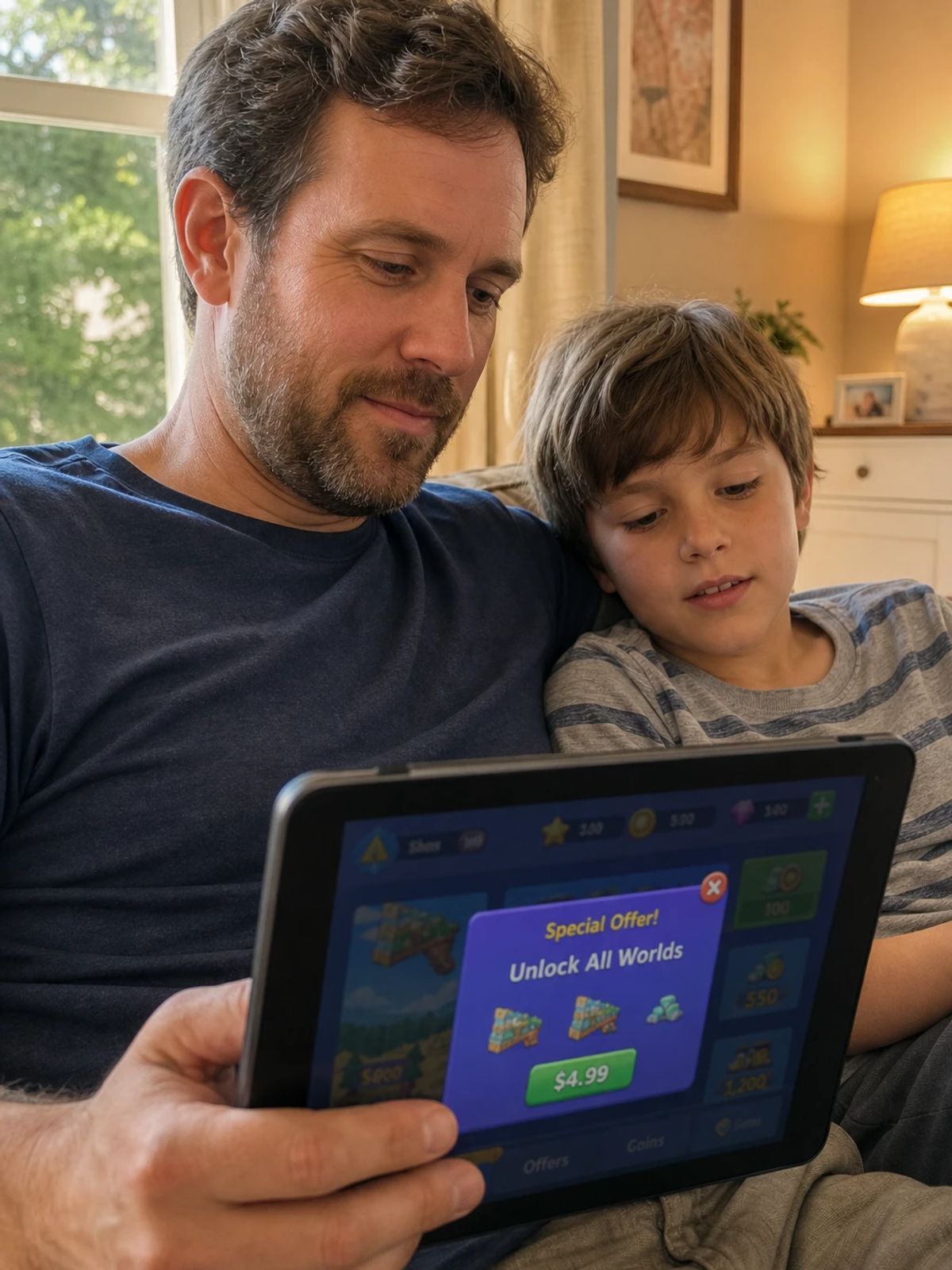
Dark Patterns in Kids Mobile Games: What Parents Need to Know
Mobile games rated for children use the same retention mechanics as casino software. That is not an accident, it is a business model.
In August 2026, Bloomberg published an investigation titled "Kid-Rated Mobile Games Use Addictive Design to Keep Players Hooked". Their finding: apps like Monopoly GO! Gossip Harbor, and Township, all carrying child-appropriate age ratings, accounted for more than half of revenue across the top 100 mobile games in 2024 and 2025. What drives that revenue is not just engagement. It is a specific set of dark patterns kids mobile games deploy, often on purpose, often on players who cannot legally sign a contract.
This post walks through those patterns by name. You do not need a game design degree to spot them once you know what to look for.
What Dark Patterns in Kids Mobile Games Actually Are
A dark pattern is a design choice that benefits the developer at the player's expense. It is not a bug. It is not an oversight. It is a feature that was specced, built, tested, and shipped.
The term was coined by UX designer Harry Brignull in 2010 to describe deceptive interfaces in e-commerce. The game industry adopted the concept and ran with it. In kids' apps the stakes are higher because the target audience has less developed impulse control, a fact developers know because they read the same developmental psychology research anyone else can.
Here are the five patterns you will encounter most often.
1. Artificial Scarcity Timers
A countdown clock tells your child they have 4 hours and 37 minutes to claim a reward before it disappears forever. The scarcity is fake. The clock will reset. The urgency is manufactured to interrupt whatever your kid was doing, homework, dinner, sleep, and pull them back into the app.
This is a textbook application of loss aversion, the well-documented cognitive bias where humans weigh potential losses more heavily than equivalent gains. In adults it nudges purchasing decisions. In children it can produce genuine distress.
2. Variable Reward Loot Boxes
A loot box is a randomized prize mechanic. You spend currency, sometimes earned in-game, sometimes purchased with real money, and receive a random item. The odds of getting the item you actually want are typically low and frequently undisclosed.
This is the slot machine mechanic. Variable ratio reinforcement, the schedule Ferster and Skinner documented in 1957, produces the behavior most resistant to extinction of any reward pattern, which is why slot machines are regulated and loot boxes in kids' games mostly are not. Yet.
In January 2025, the FTC settled an enforcement action against HoYoverse, maker of Genshin Impact, over loot box practices targeting minors. The charges included deceiving players about the odds of winning specific prizes. HoYoverse agreed to a $20 million fine and a ban on selling loot boxes to players under 16 without parental consent.
In the UK, the government told the House of Lords in January 2026 that its clear position is that loot boxes should not be purchased by children unless a parent or guardian enables it, and peers in that same session pressed for loot boxes to be recognised as a form of gambling. The regulatory machinery is moving. It is just moving slowly.
3. Pay-to-Win Mechanics
Pay-to-win means real money buys a competitive advantage. Not cosmetics. Not skips. An actual edge over other players.
In kids' apps, this creates a social dynamic where the child whose family spends more wins more. Children notice this. It produces social pressure to spend, which leads directly to the next pattern.
4. Social Pressure Mechanics
Leaderboards showing your child in last place. Notifications that a friend unlocked a rare item. Pop-ups showing what their teammate received from a loot box. These are not neutral features. They are engineered to create FOMO and translate that FOMO into spending.
The Bloomberg investigation noted that a small subset of players, called "whales" in industry language, generate a disproportionate share of revenue. The social mechanics are part of how those players are identified and cultivated.
5. Sunk Cost Design
Sunk cost design makes quitting feel like a loss. Your child has a 47-day login streak. They have a rare pet that took six weeks to evolve. They have a guild that is counting on them for tonight's raid.
None of that transfers when they stop playing. The design is intentional: accumulate enough that leaving hurts. Then monetize the discomfort.
This is not incidental. It is documented in game design literature as a retention strategy. The Bloomberg piece describes how the revenue model depends on it.
The Data Problem and COPPA
Beyond the behavioral mechanics, there is a data layer.
COPPA, the Children's Online Privacy Protection Act, restricts what personal data apps can collect from children under 13 in the US without verifiable parental consent. Many apps nominally comply by burying an age gate in onboarding. The FTC has made clear that nominal compliance and actual compliance are different things.
When you let your child download a free game, read the privacy policy before dismissing it. Specifically: what data is collected, how it is used, whether it is sold to third parties, and whether the app is actually COPPA compliant or just claims to be.
The Distinction That Matters: Earned Rewards vs. Paid Chance
Not all variable rewards are predatory. This is important to say clearly.
If you understand reward loops, and I come at this from 25 years of FPS and RPG design, so I have thought about it, there is a meaningful structural difference between two types of surprise mechanics.
An earned variable reward: your child completes a task, hits a goal, and gets a surprise outcome. The uncertainty is in what the reward is, not whether they deserve one. The behavior being reinforced is effort and follow-through.
A paid variable reward: your child (or you) spends real money for a chance at something. The behavior being reinforced is spending. The odds are set by the house.
These are not the same design. They produce different incentives and different psychological outcomes. The first is the structure behind every RPG loot drop you have ever earned by actually playing the game. The second is the structure behind loot boxes you buy with a credit card.
If you want to understand why this distinction matters at a design level, the post "Why Games Are Addictive, And How to Use It for Good" goes deeper on the mechanics. And if the word "gamification" is still fuzzy for you, "What Is Gamification, Explained" is the right starting point.
What to Actually Look For
Here is a practical checklist when evaluating any kids' app:
- Does the app require real money to access randomized rewards?
- Are there countdown timers creating artificial urgency?
- Does performance on leaderboards affect social standing in ways that pressure spending?
- Is there a clear, readable privacy policy that specifies COPPA compliance?
- Does quitting or taking a break cause the child to lose accumulated progress or status?
- Are loot box odds disclosed before purchase?
If you answered yes to any of the first two and cannot get a straight answer on the rest, that is information.
For a framework on managing the broader screen time question without guilt, "How Much Screen Time for Kids: No-Guilt Guide" is worth reading alongside this one.
How We Built Chore Battles Around This
Chore Battles is a chore tracker that runs like a game. Kids ages 6-17. Free to download on iOS and Android. No targeted ads at kids. No sale of children's data. COPPA compliant.
It uses a surprise reward mechanic. I want to be direct about that. Your kid's in-game creature grows with every chore, and hitting goals triggers transformations they do not fully predict. That is variable reinforcement. We are not pretending otherwise.
The difference is structural. Nothing in Chore Battles is purchased with real money for a random outcome. Every surprise is earned through completed chores. The behavior being reinforced is doing the dishes and making the bed, not spending your allowance on a chance at a rare skin.
There is also a weekly family boss, a new challenger each week, every chore counts as a hit against it, and the family beats it together. A family leaderboard resets every Monday, with protection for sick days and vacations. Parents get a dashboard behind a PIN and a photo verification system so they can see proof of work before points are awarded.
The rewards store lets parents set what kids can cash in their points for, screen time, treats, allowance. That is a parent-controlled layer over the whole system.
We built it this way because we were annoyed by the alternative. The design patterns described in this post are documented, deliberate, and increasingly under regulatory scrutiny. Building the opposite was not a moral statement. It was just the more interesting design problem.
If that sounds like something your family would use, the Chore Battles waitlist is at yulixis.com/chore-battles.
Chore Battles
A chore tracker that runs like a game — creatures that grow, a weekly family boss, and a leaderboard that resets every Monday. Free to download.
Join the waitlist