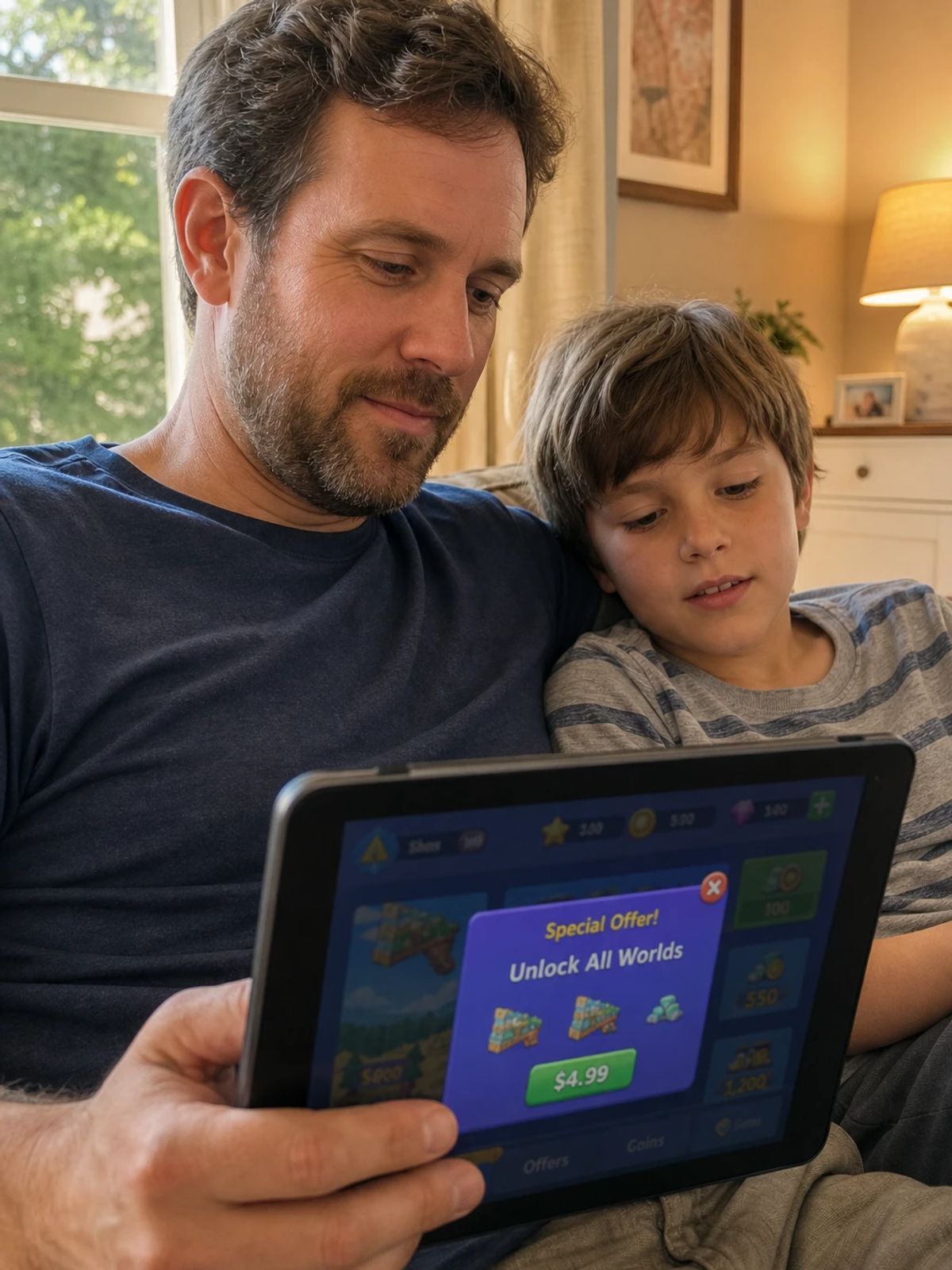
Screen Time Rules for Teens That Actually Work
Every parent has screen time rules for teens. Almost none of them stick. Here's what the 2026 research says about bedroom devices, bedtime phones, and enforcement that doesn't require you to be the bad guy every single night.

April Campos · Co-founder & CMO
· 5 min read
The rule exists in every house. "No screens after 9." "No phones at dinner." "No devices in the bedroom." Everyone has it. Nobody enforces it past week two.
That's not a parenting failure. That's a design problem.
What the Research Said This June
Two studies landed in June 2026 and they said basically the same thing, which is unusual enough to pay attention to.
A study in Acta Paediatrica surveyed nearly 8,000 kids aged 12 to 14. The ones using screens in their bedrooms overnight didn't just use more screens in the moment. A year later they still used more screens, and they showed higher rates of problematic use. The bedroom device wasn't a neutral convenience. It was a compounding factor.
A second study, published the same month in the Journal of Adolescent Health, came at the same dataset from a different angle: kids with screens in their bedrooms at night were more likely to be cyberbullied, and more likely to do it to someone else, both giving and receiving.
Two studies, same month, same conclusion. The bedroom is not a neutral location for a device.
What the Phone Is Actually Doing at Midnight
Research cited by Medical Xpress found that kids using devices right before sleep were 44% more likely to not get enough sleep, and 51% more likely to sleep poorly. Those aren't small numbers. That's not "a little tired in the morning."
And the devices are running all night whether you know it or not. Data from Screenagers shows the average young person spends almost an hour on their phone between 10 p.m. and 6 a.m. on school nights. Most of that activity happens between midnight and 4 a.m.
So the phone isn't sitting there. It's working. Your kid is working it.
The American Academy of Pediatrics has moved past simple time limits. Their current position focuses on quality, context, and conversation rather than a fixed daily number. But they are still explicit about one thing: keep devices out of bedrooms at night. That recommendation hasn't wavered.
The Rule Is Fine. The Enforcement Is Broken.
Here is what actually happens. Parent announces the rule. Kid agrees. Three days later, kid has the phone under the pillow. Parent discovers it and announces the rule again, louder this time. Kid agrees. Repeat.
The problem is not that teenagers are uniquely terrible people. The problem is that the rule has no structure behind it. It's a verbal agreement between two parties where one of them is a teenager with a fully charged phone and a social life happening on it. That is not a fair contract.
A July 2026 CNN report on battling kids over devices made the same point: enforcement is where screen time rules fall apart, not intention. Every parent intends to hold the line. Almost nobody has a system that holds it for them.
The rules that stick are the ones that don't require you to be the enforcer every single night.
Screen Time Rules for Teens That Are Actually Enforceable
These work because they change the environment, not just the policy.
1. Phones charge outside the bedroom. Every night. No exceptions.
This is the single most supported rule in the current research. Not "try to limit" or "put it face-down." Outside the room. Charging station in the hallway, the kitchen, anywhere that is not the bedroom. The rule is binary, which makes it checkable.
2. The cutoff time is a location rule, not a time rule.
Instead of "no screens after 9," make it "phone goes to the charger when you start your wind-down." Linking it to a routine (brushing teeth, getting into bed) is easier to track than watching the clock.
3. Set the device's own Do Not Disturb from 9 p.m. to 7 a.m.
Most phones let you schedule this. Notifications stop. The social feed doesn't call out to them at 1 a.m. This isn't perfect, but it reduces the pull significantly. Set it together, not unilaterally, and it's more likely to stay on.
4. Mornings before school are screen-free until after breakfast.
This one is about dopamine sequencing. Starting the day with social media before anything else sets the wrong tone for attention and mood. Breakfast first, then the phone. Simple, defensible, and you can visibly enforce it.
5. The weekend rule is the same as the weekday rule.
This is where most parents lose ground. Letting the Friday night rule slide teaches kids that the rules are negotiable under low-stakes conditions. Consistency is the mechanism. It doesn't have to be rigid, but it can't be invisible.
6. Have a written family agreement, not just a spoken one.
Write it down. Post it. This sounds corny until the third argument about what was "actually agreed to." A short written list removes ambiguity and gives the kid something to reference instead of relying on their memory of a conversation that happened while they were half-listening.
7. Build in a review date.
Tell your teen the rules are on a 90-day review. If things are going well, you'll revisit. This makes the rule feel less like a life sentence and more like a trial. They're more likely to cooperate with something that can be renegotiated than something that feels permanent.
One More Angle Worth Considering
If the fight in your house is specifically about screen time, there's a version of this problem that's worth flipping around. Instead of the rule being "no screens until chores are done" (which is a nag, and you know it), that same rule can be built into a system.
Chore Battles, our app for kids 6 to 17, has a Rewards Store where parents set whatever they want as rewards. Screen time is a common one. Kids earn points by completing chores. Points buy rewards. The rule becomes structural instead of conversational, and parents see every transaction behind a PIN-protected dashboard.
It's not a magic fix for a 14-year-old who has decided screens are non-negotiable. But it does change the shape of the argument. Instead of "I said no screens until chores are done," the question becomes "how many points have you earned this week." Different conversation.
If you want to try it, Chore Battles is free to download. Join the waitlist at Yulixis and we'll let you know when a spot opens up.
Chore Battles
A chore tracker that runs like a game — creatures that grow, a weekly family boss, and a leaderboard that resets every Monday. Free to download.
Join the waitlist