Age-by-Age Chores That Won't Start a War
A no-judgment, age-by-age chores guide for kids 5-17: what they can actually handle, what's just you avoiding a fight, and how to make the list one kids opt into.

April Campos · Co-founder & CMO
· 6 min read
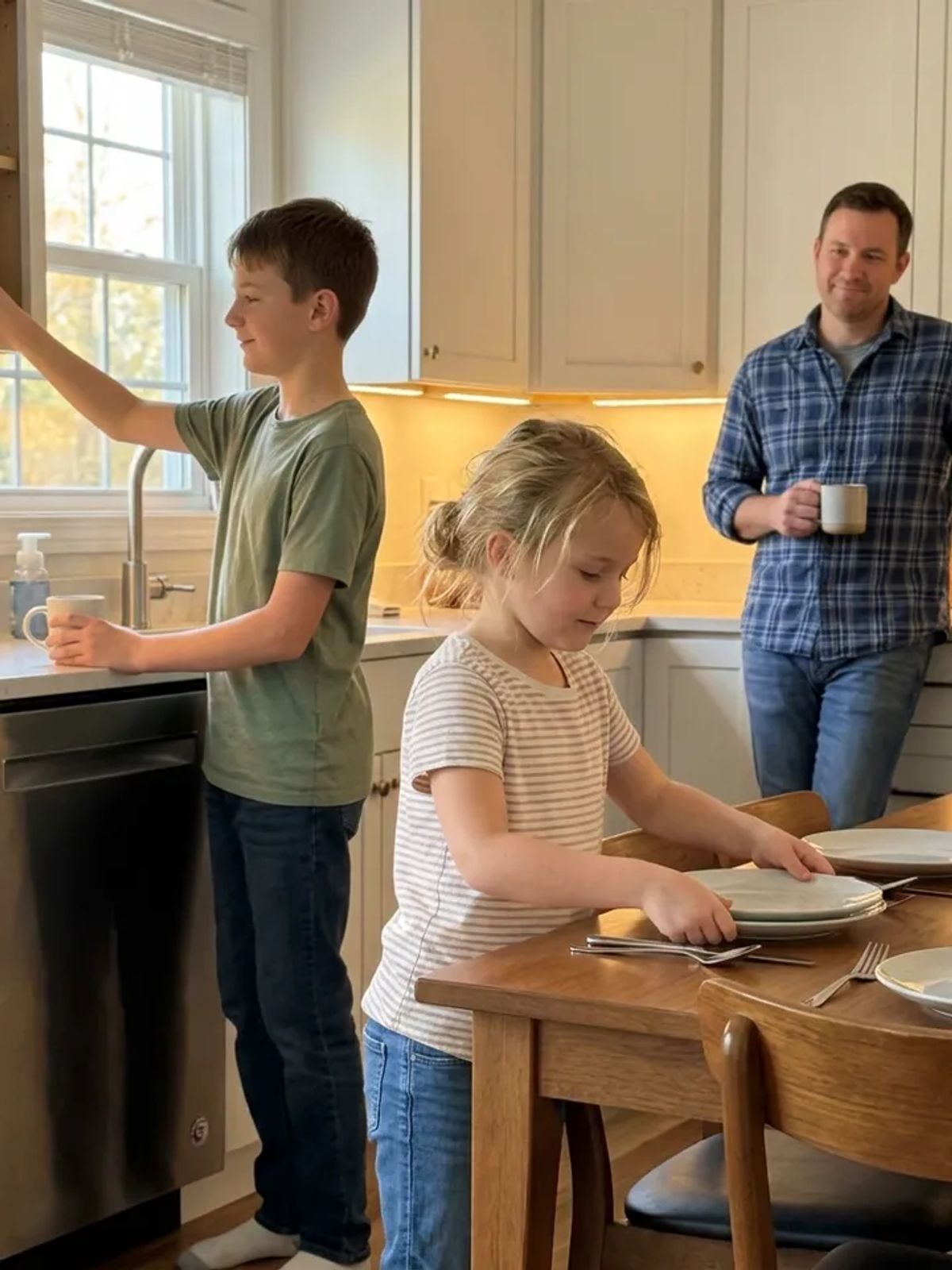
Most chore charts don't fail because the kid is lazy. They fail because the chart was built for the wrong kid.
You hand a six-year-old a laminated grid with eleven tasks on it, half of which require fine motor skills they won't have for two more years, and then you're surprised when the whole thing collapses by Thursday. That's not a discipline problem. That's a casting problem. The single most useful thing I've learned about chores by age is that the fight almost always starts when the job and the kid don't match: too hard and they shut down, too easy and they correctly clock that you're wasting their time.
So let's fix the casting. Below is an age-by-age breakdown of what kids can actually do, what's just you offloading your own anxiety, and the one move that turns the whole list from a battle into something they'll opt into. I'll get to that last part, because I'd be a hypocrite if I wrote a chores post that pretended a list alone ever fixed anything.
Why "chores by age" beats "chores by guilt"
Quick detour, because the data here is genuinely good and I'm not going to bury it.
The American Academy of Pediatrics publishes age-appropriate chore guidance for a reason: a kid's capacity is developmental, not motivational. And the long-game case is stronger than most parents realize. A University of Minnesota study led by Marty Rossmann found that participating in household tasks early (around age three or four) was the best predictor of young adults' success in their mid-twenties. Kids who started early were more self-sufficient, did better in school and early careers, and had stronger relationships than kids who started as teens or never started at all.
Here's the part nobody quotes: the same research found that kids who didn't start until their teens, or never started at all, came out worst. Wait too long and the kid reads the chore as a punishment you invented, not a normal part of being a person in a house. The window matters. Which is exactly why a one-size list is useless.
The age-by-age chore list (and what to skip)
I'm anchoring the bands to the AAP's framework and then telling you the truth about each one.
Ages 5-7: the "I want to help" window. Do Not Waste It
This is the golden age and you will not believe me until it's gone. Five-to-seven-year-olds genuinely want to do the thing. They think a spray bottle is a toy. Use it.
- Make their own bed (it will be bad; let it be bad)
- Set and clear the table
- Put toys and laundry away
- Feed a pet, water plants
- Dust, with the aforementioned spray bottle of pure joy
Skip: anything with a verdict attached. If you redo the bed in front of them, you just taught them their work doesn't count. The AAP's own line is to praise the effort, not the outcome. Resist. I know.
Ages 8-10: capability jumps, supervision drops
Now you get real labor. Eight-to-ten-year-olds can handle multi-step jobs and start owning a result instead of just a task.
- Vacuum
- Help make dinner (actual cooking, supervised)
- Make their own snacks and lunches
- Take the dog for a walk
- Start their own laundry loads
Skip: the trap of doing it faster yourself. Yes, you can vacuum in four minutes. The point was never the carpet.
Ages 11-12: full household competence, lower glamour
By now there's almost nothing in a normal house they can't physically do. The jobs just get less fun, which is its own lesson.
- Clean the kitchen and bathroom
- Change their own sheets
- Load and unload the dishwasher
- Wash, dry, and fold laundry start to finish
- Scrub the toilet (welcome to adulthood)
Skip: surprise inspections. Eleven-year-olds have a finely tuned hypocrisy detector and you do not want to fail it.
Ages 13-17: stop assigning, start co-owning
This is where chore charts go to die, and it's because teenagers don't want to be managed; they want to be trusted. The AAP keeps chores in the picture through adolescence for a reason: this is the dress rehearsal for living alone.
- Cook a full meal the family actually eats
- Manage their own laundry on their own schedule
- Yard work, taking out trash and recycling, basic car care
- Grocery runs, errands, watching younger siblings
- Owning a recurring zone of the house outright (it's theirs, no reminders)
Skip: the nag. With a teenager, the reminder is the conflict. The goal is a system where the thing happens without you being the bad guy every single time.
The list is the easy part. The opt-in is the whole game.
Here's where I put my marketing hat on, because seeing the mechanics behind why things work is literally my job, and chores are a motivation design problem wearing a chores costume.
Every functional chore list runs into the same wall: you've defined what to do but not why they'd want to. Sticker charts try to solve this and die in a week because a sticker is a reward a four-year-old respects and a nine-year-old sees right through. Allowance helps until it becomes a flat transaction they can negotiate. The thing that actually moves kids isn't bribery. It's a loop that makes finishing the task feel like progress toward something they chose.
That's the part we built our whole studio around, and I'm not going to pretend otherwise.
Where Chore Battles fits (the low-pressure pitch)
My husband AJ has spent twenty-some years in games, and the thing he says that stuck with me: the best games don't make you do work, they make doing the work feel like the reward. So we took an age-by-age chore list (the same kind you just read) and built it into a game kids actually opt into. It's called Chore Battles, it's for kids 6-17, and it works like this:
- Every chore feeds a creature that grows and transforms as your kid hits goals. The list stops being a list and becomes the thing leveling up their guy.
- A weekly boss the whole family fights together: every completed chore anyone does lands a hit. It's the house versus the boss, not sibling versus sibling. (We deliberately left out the kid-on-kid competition. I have siblings. I know how that ends.)
- A friendly family leaderboard that resets every Monday, with sick days and busy weeks protected so one rough day doesn't torch a kid's whole week.
- Photo verification so you see the proof, and a rewards store where you set the prizes (screen time, treats, allowance, whatever your house runs on) and kids cash in points they earned.
And yes, there's a surprise-reward, gacha-style element to it, because I'm a marketer and I'm not going to insult you by pretending variable rewards aren't powerful. They are, and it's the same loop that keeps adults pulling slot levers and refreshing feeds. The difference is ours are earned through chores, delightful, with no real-money loot boxes aimed at your kid. Ethical variable rewards, not predatory ones. We're COPPA compliant, we don't run targeted ads at kids, and we don't sell data. That's the whole line.
The age list above is genuinely useful on its own. Print it, tape it to the fridge, ignore me. But if you've already taped three lists to that fridge and watched them all die by Thursday, the problem was never the list. It was the missing why. That's the gap we built into a game.
Join the Chore Battles waitlist here. Match the job to the kid, build in a reason they care, and stop being the only person in the house who remembers the trash goes out on Tuesday. You did not sign up to be a household reminder app. I checked.
Chore Battles
A chore tracker that runs like a game — creatures that grow, a weekly family boss, and a leaderboard that resets every Monday. Free to download.
Join the waitlist